


What if the windows in your home are quietly costing you hundreds of dollars every year? It’s a frustrating reality many homeowners face: energy bills that creep higher each season, rooms that feel like an oven in summer and a freezer in winter, and a growing pile of confusing advice about what to do about it.
You’re not alone in feeling overwhelmed by window technology. Most people know their windows play a role in home comfort, but understanding exactly how to fix the problem is another story entirely. Low-E glass windows are one of the most practical and effective upgrades available to homeowners today, and the good news is that the science behind them is simpler than you might think.
In this article, you’ll learn exactly what Low-E glass does, why it makes such a measurable difference in energy efficiency and year-round comfort, and what to look for when considering a window upgrade. By the end, you’ll have a clear, confident understanding of whether this investment is the right move for your home.
Key Takeaways
- Low-E glass windows feature a microscopic coating that reflects heat, helping to reduce energy loss and keep your home comfortable in every season.
- Upgrading to Low-E glass can meaningfully lower your energy bills by improving insulation and reducing the strain on your heating and cooling systems.
- Several common myths surround Low-E glass — including concerns about cost and durability — and understanding the facts can help you make a smarter, more confident investment.
- The performance of Low-E glass depends heavily on proper installation, making the choice of an experienced local installer a critical part of achieving real energy savings.
- By the end of this article, you’ll know exactly what to look for in a Low-E glass upgrade and how to evaluate whether it’s the right fit for your home’s specific climate and needs.
Understanding Low-E Glass: What Homeowners Need to Know
Most homeowners have heard the term “Low-E glass” thrown around by contractors or spotted it on a window product label, but few understand what it actually means in practical terms. That knowledge gap matters, because the difference between standard glass and Low-E glass windows can have a real, measurable impact on how comfortable your home feels and how much you spend keeping it that way.
What is Low-E Glass?
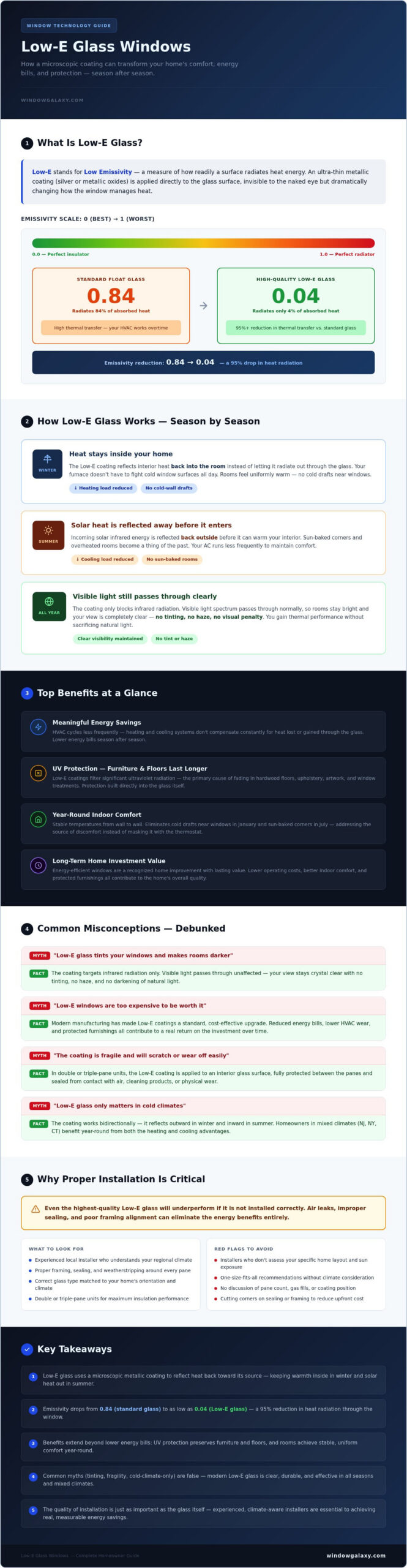
“Low-E” stands for low emissivity, a term that describes how readily a surface radiates heat energy. Glass on its own is a poor insulator. It absorbs and releases heat easily, which is exactly what you don’t want when you’re trying to keep warmth inside during a cold New Jersey winter or block it out during a sweltering August in the tri-state area.
To solve this, manufacturers apply an ultra-thin metallic coating, typically just a few layers of silver or other metallic oxides, directly to the glass surface. This coating is so thin it’s essentially invisible to the naked eye. You won’t notice any change in your view, but the physics of how that glass behaves changes dramatically. Low-E coatings were first developed in the 1970s and have been continuously refined since, with modern versions offering significantly better performance than early iterations.
How Does Low-E Glass Work?
Here’s where it gets genuinely interesting. All objects emit infrared radiation, which is essentially heat energy. Standard glass allows a large portion of that energy to pass straight through, in both directions. The Low-E coating acts as a reflective barrier, bouncing heat back toward its source rather than letting it escape or enter freely.
In practical terms, this means:
- In winter: Heat generated inside your home is reflected back into the room instead of radiating out through the glass.
- In summer: Solar heat from outside is reflected away before it can warm your interior spaces.
- Year-round: Visible light still passes through clearly, so your rooms stay bright without the thermal penalty of single-pane or standard double-pane glass.
Emissivity is measured on a scale from 0 to 1. Standard float glass typically has an emissivity value around 0.84, meaning it radiates most of the heat it absorbs. High-quality Low-E coatings can bring that value down to 0.04 or lower, a substantial reduction in thermal transfer that your heating and cooling system will notice immediately.
The result is a window that works smarter, not just harder, keeping your home’s climate stable without demanding constant compensation from your HVAC system.
Top Benefits of Low-E Glass Windows for Your Home
Understanding how Low-E glass works is one thing. Knowing what that actually means for your daily life is another. The benefits go well beyond a lower utility bill, touching everything from the longevity of your furniture to how much street noise filters into your living room. Here’s what homeowners in the NJ, NY, and CT region consistently notice after making the upgrade.
Energy Savings and Comfort
The most immediate benefit most homeowners notice is a more stable indoor temperature. Without effective window insulation, your HVAC system works overtime to compensate for heat lost in winter and heat gained in summer. Low-E glass windows reduce that thermal transfer, which means your heating and cooling systems don’t have to cycle as frequently or run as long to maintain a comfortable temperature.
The practical result is twofold: lower energy bills and rooms that actually feel comfortable from wall to wall. Cold drafts near windows in January and sun-baked corners in July are both symptoms of underperforming glass. Addressing the source of the problem, rather than just cranking up the thermostat, is a smarter long-term approach. If you’re weighing this upgrade alongside other home improvements, this guide to energy-efficient home improvements is a useful starting point for understanding how window replacement fits into a broader efficiency strategy.
UV Protection and Durability
Here’s a benefit that often surprises homeowners: Low-E coatings filter a significant portion of ultraviolet radiation before it enters your home. UV rays are the primary cause of fading in hardwood floors, upholstered furniture, artwork, and window treatments. Standard glass offers very little protection against this kind of gradual damage.
With Low-E glass, that protection is built directly into the window itself. Your furnishings retain their color and integrity longer, which has real financial value when you consider the cost of replacing flooring or reupholstering furniture. While Low-E glass is an excellent built-in option, professional architectural film solutions from experts like Blackout Film provide another effective way to manage heat and UV exposure for existing residential and commercial windows.
Noise Reduction
Low-E glass windows are typically paired with double or triple-pane configurations, and that added glazing provides a meaningful buffer against outdoor noise. If your home sits near a busy road, a train line, or a neighborhood with heavy foot traffic, the difference in ambient sound levels after an upgrade is often immediately noticeable. It’s a benefit competitors rarely highlight, but one that homeowners consistently appreciate once they experience it firsthand.
Considering a window upgrade? Exploring your options with an experienced local installer is the best way to identify which configuration makes the most sense for your home’s specific layout and climate exposure.
How Low-E Glass Windows Enhance Energy Efficiency
Energy efficiency isn’t a single feature. It’s the result of multiple systems working together, and Low-E glass windows sit at the center of that equation for most homes. Understanding how the coating interacts with heat and light at a physical level makes it much easier to evaluate whether this upgrade is the right fit for your specific situation.
The Science Behind Low-E Coatings
Radiant heat transfer is the mechanism responsible for most of the thermal loss that happens through standard glass. When a warm surface emits infrared radiation, that energy moves outward in all directions, including straight through your windows and into the cold air outside. The Low-E metallic coating interrupts this process by reflecting a substantial portion of that infrared energy back before it can escape.
What makes this particularly effective is that the coating responds differently to different types of energy. It allows visible light to pass through with minimal interference while selectively blocking the infrared wavelengths responsible for heat gain and loss. Solar energy enters the equation here too. Depending on the specific coating formulation, Low-E glass can be tuned to either admit or reject solar heat, which matters enormously depending on your climate and the orientation of your windows.
For homeowners in the NJ, NY, and CT region, where winters are genuinely cold and summers bring real heat and humidity, this selective behavior is a practical advantage. A coating optimized for a mixed climate can help retain warmth in January while keeping solar heat gain in check come July.
Optimizing Your Windows with Low-E Technology
The coating itself delivers meaningful results, but its performance improves significantly when paired with the right supporting components. Insulated frames prevent thermal bridging at the edges, where heat transfer often continues even when the glass performs well. Multi-pane glazing adds another layer of resistance, with the gas-filled space between panes slowing conductive heat transfer that the coating alone can’t address.
Choosing the right configuration for your home depends on several factors:
- Window orientation: South-facing windows benefit from different coating specifications than north-facing ones.
- Frame material: Vinyl frames, like those available through Galaxy Vinyl Windows, offer strong thermal resistance without the maintenance demands of wood.
- Climate zone: Mixed-climate regions call for balanced coatings that perform across seasonal extremes rather than optimizing for just one condition.
There’s also an environmental dimension worth considering. When your home retains heat more effectively in winter and deflects it more efficiently in summer, your HVAC system consumes less energy overall. That reduction in energy demand has a measurable downstream effect on your household’s carbon footprint, without requiring any change in how you live day to day.
If you’re thinking about how Low-E technology fits into a broader window design strategy, exploring your custom windows options is a smart next step. Getting the coating, frame, and glazing configuration right from the start is what transforms a good window into one that genuinely performs for decades.
Common Misconceptions About Low-E Glass Windows
Misinformation travels fast, especially in home improvement circles. Homeowners researching Low-E glass windows often encounter a mix of genuine expert advice and unverified opinions from online forums, and sorting one from the other isn’t always straightforward. A few persistent myths have caused some homeowners to delay or dismiss an upgrade that would genuinely benefit them. Here’s what the facts actually say.
Myth: Low-E glass distorts your view or darkens your rooms. This is one of the most common concerns, and it’s largely unfounded with modern coatings. The metallic layer applied to Low-E glass is engineered to selectively filter infrared wavelengths while allowing visible light to pass through with minimal interference. In practical terms, your rooms stay bright and your view remains clear. Early Low-E products from decades ago did sometimes produce a slight tint, but today’s formulations have largely eliminated that issue.
Myth: Low-E glass requires special cleaning products or complicated maintenance. It doesn’t. The coating is bonded to the glass surface during manufacturing and is protected within the sealed unit in double or triple-pane configurations. Standard glass cleaning practices apply. You don’t need specialty solutions or unusual techniques to keep the windows performing well. For a broader overview of how to care for your windows over time, this window maintenance guide covers the essentials in plain terms.
Myth: Low-E glass is a universal solution that performs the same in every home. This one requires a more nuanced answer. The coating type, glazing configuration, and frame material all need to match your home’s specific climate exposure and window orientation. A configuration optimized for a cold northern climate performs differently than one designed for a mixed-climate region like the NJ, NY, and CT area. Getting the right setup requires an honest conversation with an experienced installer who understands your local conditions, not a one-size-fits-all product recommendation.
Is Low-E Glass Worth the Investment?
The upfront cost of Low-E glass windows is higher than standard alternatives. That’s a straightforward fact. But evaluating that cost in isolation misses the full picture. The relevant comparison is total cost over time, factoring in reduced energy consumption, longer intervals between HVAC servicing, and the preservation of interior furnishings from UV degradation. For most homeowners in climates with genuine seasonal variation, the long-term math tends to favor the upgrade. The best way to evaluate your specific situation is to consult with a knowledgeable local installer who can assess your home’s actual performance gaps rather than offer a generic estimate. Ready to get a clearer picture? Talk to the Window Galaxy team about what Low-E glass could realistically deliver for your home.
Why Choose Window Galaxy for Low-E Glass Installation
Choosing the right glass is only half the equation. The other half is who installs it. Even the most technically advanced Low-E glass windows will underperform if the installation is rushed, misaligned, or handled by someone unfamiliar with the specific demands of your local climate. That’s where the difference between a competent installer and the right installer becomes very real, very quickly.
Our Expertise in Low-E Glass Technology
Window Galaxy has built its reputation on one straightforward principle: quality work, communicated clearly, delivered on time. The team brings hands-on experience with window installations across the NJ, NY, and CT region, a tri-state area with genuine seasonal extremes that demand precise product selection and careful installation technique. That regional knowledge matters. A window configured for a mild southern climate won’t perform the same way in a New Jersey winter, and understanding those distinctions is what separates a knowledgeable installer from a general one.
Every project begins with a thorough assessment of your home’s specific conditions, including window orientation, existing framing, and how your current setup is affecting indoor comfort. From there, the conversation is collaborative. You’ll understand exactly what’s being recommended and why, before any work begins. If you’re still evaluating your options, this guide to choosing a window replacement company outlines the key questions every homeowner should ask before committing to an installer.
A Customer-Centric Approach from Start to Finish
Transparent communication isn’t a talking point at Window Galaxy; it’s how every project is managed. Homeowners receive clear timelines, honest assessments, and consistent updates throughout the process. There are no surprises buried in the fine print and no handoffs to unfamiliar crews mid-project.
What that looks like in practice:
- Honest product recommendations based on your home’s actual needs, not a one-size-fits-all upsell
- Responsive communication at every stage, from initial consultation through final walkthrough
- Meticulous installation standards that protect the long-term performance of your windows
- Local expertise that accounts for regional climate patterns specific to the tri-state area
The goal is simple: you should feel more confident at the end of the process than you did at the start. If you’re ready to find out what a properly installed, correctly specified window upgrade could realistically deliver for your home, reach out to the Window Galaxy team to start the conversation.
Your Home Deserves Windows That Actually Work For You
Low-E glass windows aren’t a luxury upgrade. For homeowners dealing with uncomfortable rooms, rising energy bills, and fading furnishings, they’re a practical solution backed by real science. The coating technology reduces heat transfer in both directions, your HVAC system works less, and your home stays comfortable across every season.
Getting the most out of that technology comes down to two things: choosing the right configuration for your specific climate and having it installed correctly from the start. That’s where local expertise genuinely matters. Window Galaxy serves homeowners across NJ, NY, and CT with the regional knowledge and meticulous installation standards that protect your investment long-term.
You don’t have to figure this out alone. The right window upgrade starts with an honest conversation about your home’s actual needs, not a generic product pitch.
Schedule your free window consultation with Window Galaxy today! A more comfortable, energy-efficient home is well within reach.
Frequently Asked Questions About Low-E Glass Windows
What is Low-E glass and how does it work?
Low-E glass, short for low emissivity glass, features an ultra-thin metallic coating applied directly to the glass surface. This coating reflects infrared heat energy rather than allowing it to pass freely through the pane. Standard glass has an emissivity rating around 0.84, meaning it radiates most absorbed heat. High-quality Low-E coatings can reduce that figure to 0.04 or lower, dramatically cutting the amount of heat that transfers in either direction.
Are Low-E glass windows worth the investment?
For most homeowners in climates with real seasonal variation, yes. The upfront cost is higher than standard glass, but the relevant comparison is total cost over time. Reduced energy consumption, less strain on your HVAC system, and protection of interior furnishings from UV damage all contribute to long-term value. The best way to evaluate your specific situation is to consult with an experienced local installer who can assess your home’s actual performance gaps rather than rely on a generic estimate.
How does Low-E glass compare to regular glass?
Regular glass offers very little resistance to heat transfer in either direction. It absorbs and releases thermal energy easily, which forces your heating and cooling systems to work harder to compensate. Low-E glass windows selectively filter infrared wavelengths while still allowing visible light through clearly. The result is a window that manages heat far more intelligently, keeping warmth inside in winter and deflecting solar heat in summer, without sacrificing natural light or your view.
Can Low-E glass help reduce my energy bills?
Yes, and the mechanism is straightforward. When your windows reduce thermal transfer, your HVAC system doesn’t need to cycle as frequently or run as long to maintain a consistent indoor temperature. That reduced workload translates directly into lower energy consumption. The actual savings depend on your home’s size, insulation levels, window orientation, and local climate, which is why talking with a knowledgeable installer about your specific setup gives you a more accurate picture than any general estimate could.
Is Low-E glass suitable for all climates?
Low-E glass performs well across a wide range of climates, but the right coating formulation varies depending on where you live. Some coatings are optimized to admit solar heat in colder regions, while others prioritize heat rejection in warmer areas. For homeowners in mixed-climate regions like New Jersey, New York, and Connecticut, a balanced coating that performs across seasonal extremes is typically the most practical choice. Getting that specification right is one of the most important reasons to work with an installer who knows your local conditions.
What maintenance does Low-E glass require?
Low-E glass windows don’t require any special maintenance beyond standard glass cleaning practices. The metallic coating is bonded to the glass during manufacturing and sits protected within the sealed unit in double or triple-pane configurations, so it won’t peel, scratch, or degrade under normal conditions. You don’t need specialty cleaning solutions or unusual techniques. Routine cleaning with standard products is all it takes to keep the glass looking and performing its best.
How can I tell if my windows have Low-E glass?
One simple test is to hold a flame or lit match near the glass and observe its reflection. Standard glass reflects a consistent color across all panes, while Low-E glass typically shows one reflection with a slightly different color, usually blue or green, due to the coating. You can also check for a National Fenestration Rating Council (NFRC) label on the window frame, which will list performance ratings that indicate whether a Low-E coating is present. If you’re unsure, a qualified installer can assess your existing windows quickly.
Will Low-E glass affect the clarity of my windows?
Modern Low-E glass windows are engineered to allow visible light through with minimal interference, so your rooms stay bright and your view remains clear. Early versions of the technology sometimes produced a faint tint, but today’s coating formulations have largely eliminated that issue. The coating targets infrared wavelengths rather than visible light, which is exactly what makes it effective at managing heat without compromising the appearance of your windows or the quality of light inside your home.
