


Meeting the minimum building code for your windows might actually be the reason your New Jersey energy bills are still climbing. It’s frustrating to invest in home improvements only to feel a chill every time you walk past a glass pane during a January freeze. You aren’t alone if those NFRC labels feel like a confusing mix of numbers and jargon. Finding the best U-factor for windows in new jersey is the primary step toward stopping heat loss and finally making every room in your house comfortable again.
At Window Galaxy USA, we prioritize your peace of mind by acting as your dedicated project partner. We know that choosing the right glass is a significant decision for your family. This guide will clarify the exact ratings you need to maximize your efficiency for the 2026 season. We’ll break down the latest ENERGY STAR Version 7.0 requirements, which recommend a U-factor of 0.22 or lower for Northern NJ and 0.25 or lower for the southern part of the state. You will discover how these specific numbers lead to lower energy consumption, consistent indoor temperatures, and a window investment that you can feel confident about for years to come.
Key Takeaways
- Understand why a lower U-factor is the most critical rating for preventing heat loss and how it differs from traditional insulation measurements.
- Learn why a rating of 0.22 or lower is considered the best U-factor for windows in new jersey to combat the state’s extreme temperature swings.
- Discover how multi-chambered vinyl frames and advanced spacers work together to enhance your window’s overall thermal performance.
- Find out how to balance U-factor with Solar Heat Gain Coefficient (SHGC) to ensure your home stays warm in winter and cool during humid NJ summers.
- See how professional installation ensures your NFRC ratings actually translate to lower energy consumption and consistent indoor comfort.
Understanding U-Factor: Why It Is the Most Critical Number for New Jersey Homeowners
When the wind starts howling across the Garden State in mid-January, your windows are the only thing standing between your family and the freezing air. You might have heard about R-values when insulating your attic, but for your glass, the U-factor is the number that truly matters. This rating measures the rate at which heat escapes your living space. Selecting the best U-factor for windows in new jersey isn’t just a technical choice; it’s a commitment to your home’s long-term comfort. A lower number means the window performs better at keeping your expensive furnace heat exactly where it belongs. At Window Galaxy USA, we believe that understanding these ratings is the first step toward a stress-free home improvement experience.
High-performance windows act as a sophisticated thermal barrier. Think of it as a shield that reflects heat back into your rooms instead of letting it bleed out into the cold night. This is especially important for New Jersey residents who face rising energy costs. When your windows have a superior U-factor, your HVAC system doesn’t have to work nearly as hard to maintain a steady temperature. This leads to a more peaceful home environment where you don’t have to constantly adjust the thermostat or huddle under blankets just because you’re sitting near a window.
U-Factor vs. R-Value: What Is the Difference?
Higher R-values are better for insulation because they resist heat flow. Windows work differently. We look at the U-factor to see how much heat is actually lost through the unit. It’s vital to look at the whole-unit rating rather than just the center-of-glass measurement. Modern insulated glazing units are designed to act as a complete system. When you insist on NFRC-certified ratings, you’re ensuring that the frame, spacers, and glass all work together to protect your home. We’ve found that this transparency helps homeowners feel much more confident in their investment. It’s about knowing exactly how your product will perform before it’s even installed.
The Impact of New Jersey Weather on Window Performance
New Jersey weather is uniquely demanding on building materials. Our state can see temperature swings of 100 degrees or more between the peak of July and the depths of January. During a brutal Nor’easter, the thermal integrity of your window frames is tested by high winds and driving rain. Choosing the best U-factor for windows in new jersey ensures that the glass doesn’t become ice-cold to the touch during these events. This also helps manage the heavy humidity we face in the summer months. When the interior glass surface stays at a more consistent temperature, you’ll see a reduction in the condensation that often puzzles homeowners. It’s a simple way to protect your sills and frames from moisture damage while keeping your view crystal clear.
The Golden Number: What Is the Best U-Factor for New Jersey Windows in 2026?
Finding the best U-factor for windows in new jersey requires looking past the bare minimums required by law. While standard building codes often settle for a 0.30 rating, the true gold standard for 2026 is a U-factor of 0.22 or lower. This shift is largely driven by ENERGY STAR Version 7.0, which moved the goalposts to ensure homes can handle increasingly volatile weather. Many homeowners find that while a 0.27 or 0.30 rating technically passes inspection, it doesn’t provide the high-performance relief they expect during a deep freeze. Investing in a lower U-factor provides a vital buffer against rising energy costs. It’s a proactive way to ensure your home remains a sanctuary even when utility rates spike.
We see ourselves as your project partners, and that means being honest about performance. A window with a 0.22 U-factor is significantly more effective at stopping heat loss than the standard options found in big-box stores. This isn’t just about saving a few dollars on a monthly bill. It’s about the physical comfort of your family. When you choose a high-efficiency rating, you’re eliminating those cold spots that make certain rooms unusable in the winter. You’re choosing a home that maintains a consistent, cozy temperature from the floor to the ceiling.
Meeting vs. Exceeding New Jersey Energy Codes
Building codes represent the floor, not the ceiling. For new construction in Zone 5 (Northern NJ), the code requires a 0.30 U-factor, while Zone 4 (Southern NJ) allows 0.32. However, for replacement projects, we recommend aiming for 15-20% better efficiency than these minimums. As detailed in the New Jersey Green Building Manual, high-performance envelopes are essential for our specific climate. Choosing units designated as “Most Efficient” by ENERGY STAR ensures you’re getting the highest level of protection available today. This commitment to quality workmanship and superior products is what sets a successful renovation apart from a basic repair.
Triple-Pane vs. Double-Pane Performance
Reaching a U-factor of 0.20 or lower usually requires moving beyond standard double-pane glass. Triple-pane technology adds a third layer of glass and a second chamber for inert gases like Argon or Krypton. These gases are much denser than air, which helps them significantly slow down the transfer of heat. The ideal U-factor range for NJ is 0.17 to 0.22 for maximum comfort. Our team can help you explore how Galaxy Vinyl Windows use these advanced technologies to meet the most demanding efficiency standards. By utilizing these high-performance solutions, you ensure your window investment is protected against future energy price increases and changing climate demands.
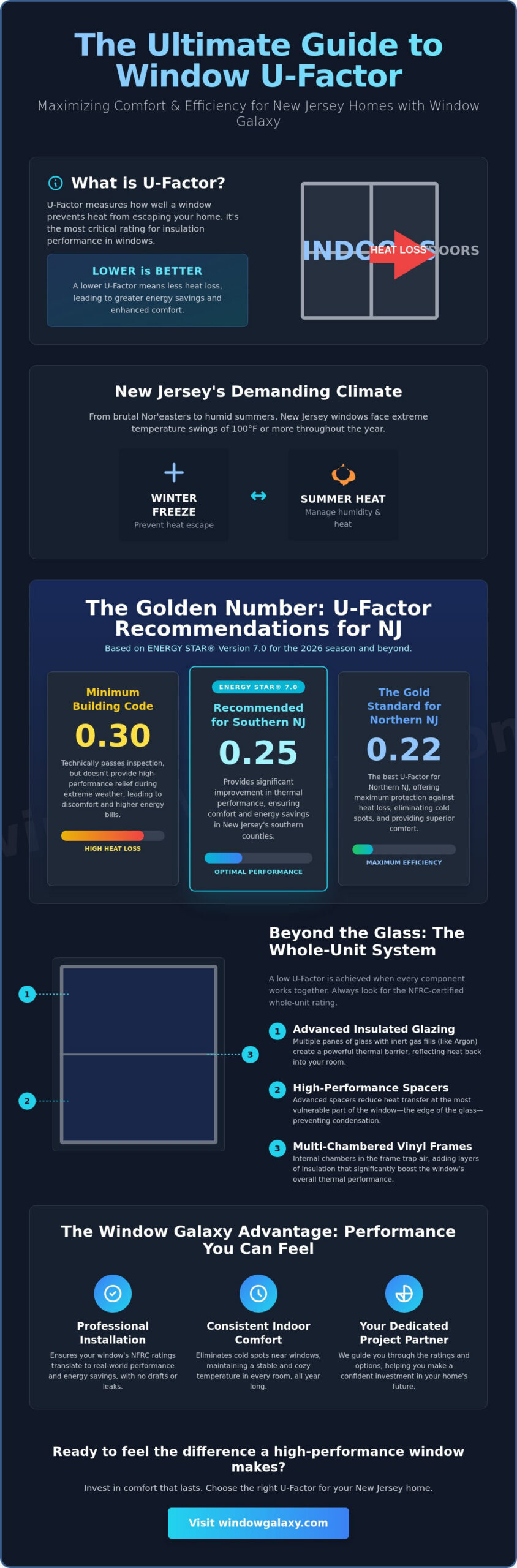
Beyond the Glass: How Frame Material and Spacers Impact Your U-Factor
Achieving the best U-factor for windows in new jersey requires a holistic look at the entire window system. While we have previously discussed how glass and gas fills stop heat loss, the frame often acts as a thermal bridge where energy secretly escapes. At Window Galaxy USA, we focus on the entire unit to ensure the performance on the NFRC label is exactly what you feel in your home. A high-quality frame prevents the edges of your windows from becoming ice-cold during a February freeze. It’s about providing a comprehensive commitment to your home’s comfort by selecting materials that stand up to the Northeast’s humidity and extreme temperature swings.
The U.S. Department of Energy provides Energy Performance Ratings that highlight how every component contributes to the final U-factor. If the frame material isn’t up to the task, even the most advanced triple-pane glass won’t reach its full potential. We believe that professional, meticulous project management means looking at the small details that others might miss. This ensures the best U-factor for windows in new jersey is realized in your actual living room, not just on a technical spec sheet. When every part of the window works together, you get a more reliable product and lower energy consumption.
The Advantage of Multi-Chambered Vinyl Frames
Air is one of the best insulators when it’s trapped in small, stagnant spaces. High-quality vinyl frames feature multi-chambered designs that create internal air pockets. These pockets act as additional insulation layers, significantly boosting the window’s ability to resist heat transfer. Rigid vinyl is superior for maintaining a tight seal over decades because it doesn’t warp like wood or conduct cold like metal. We ensure every unit features fusion-welded corners. This process creates a permanent, airtight bond that prevents air leakage and heat loss at the most vulnerable points of the window frame. It’s a level of accuracy and attention to detail that gives our clients long-term peace of mind.
High-Performance Spacers and Thermal Breaks
The spacer is the small piece of hardware that maintains the precise gap between your glass panes. In the past, these were often made of aluminum, which conducted cold directly into your home. Modern “warm-edge” technology uses non-conductive materials to prevent the edges of the glass from becoming cold spots. This is a must-have for any NJ window replacement because it reduces the risk of seal failure and condensation. By keeping the glass edges warmer, these spacers help maintain the integrity of the inert gas fill we discussed in previous sections. This ensures your windows perform at their peak for their entire lifespan, regardless of how many Nor’easters hit the coast.
Balancing U-Factor with Solar Heat Gain: Keeping NJ Homes Comfortable Year-Round
While securing the best U-factor for windows in new jersey is vital for winter warmth, focusing solely on that number can lead to unintended consequences in the summer. You don’t want to turn your living room into a greenhouse during a humid July afternoon. This is where the Solar Heat Gain Coefficient (SHGC) comes into play. While the U-factor keeps your furnace heat inside, the SHGC controls how much heat from the sun enters your home. In our four-season climate, finding a balance between these two metrics is the key to year-round comfort and lower utility bills. Choosing the wrong balance can make your HVAC system work twice as hard during the cooling season.
Low-E glass coatings serve as the secret sauce in this equation. These microscopic, metallic layers allow you to achieve a low U-factor without sacrificing the clarity of your glass. They act like a two-way mirror for thermal energy. In the winter, they reflect your home’s heat back toward the interior. In the summer, they bounce the sun’s harsh infrared rays back outside. At Window Galaxy, we take the stress out of this selection process by helping you choose the right coating for your home’s unique layout. We look at your project as a partnership, ensuring every window is optimized for its specific location and exposure.
The Ideal SHGC for the Northeast
For New Jersey homeowners, a balanced SHGC typically falls between 0.20 and 0.40. This range allows some beneficial passive solar heating during the winter while preventing excessive heat buildup in the summer. The orientation of your home matters more than you might think. South-facing windows often benefit from a lower SHGC to block intense afternoon sun; north-facing windows can prioritize a lower U-factor since they receive less direct sunlight. Matching these coatings to your home’s orientation is a level of accuracy and attention to detail that ensures your investment truly pays off in every season.
Visible Transmittance: Don’t Sacrifice Your View
A common concern we hear is that high-performance glass will look dark or tinted. Modern technology has advanced to the point where you can have maximum light with minimum heat transfer. Visible Transmittance (VT) measures how much natural light comes through the pane. You can maintain a high VT while still enjoying the best U-factor for windows in new jersey. Natural light has significant psychological benefits, making your home feel larger and more inviting. We believe you should never have to choose between a bright, sunny room and a well-insulated one. It’s about achieving high performance without compromising your home’s aesthetic appeal.
If you’re ready to see how these advanced coatings can transform your home comfort, explore our Galaxy Vinyl Windows to find the perfect match for your needs.
Maximizing Energy Efficiency with Window Galaxy’s High-Performance Solutions
Selecting the best U-factor for windows in new jersey is a major step toward a more comfortable home, but the product is only half of the story. Even a window with a perfect rating can fail to perform if it isn’t installed with precision. At Window Galaxy, our Galaxy Vinyl Windows are engineered specifically to thrive in the Tri-State area’s unique climate. We don’t just meet the industry standards; we focus on surpassing standard requirements to ensure your home remains a sanctuary regardless of the weather outside. Our team understands that a window replacement is a significant investment in your family’s peace of mind, and we treat every project with the meticulous care it deserves.
Our commitment to quality workmanship means that the NFRC U-factor rating you see on the label is exactly what you get in your home. We’ve seen how poorly executed installations can lead to drafts and energy loss, effectively canceling out the benefits of high-performance glass. That’s why we prioritize a structured project management style that leaves no room for error. When you choose our professional installation services, you’re choosing a partner dedicated to your long-term satisfaction. We ensure every frame is perfectly leveled, sealed, and insulated to provide the thermal barrier your New Jersey home needs.
The Window Galaxy Difference: Quality Control and Communication
What sets us apart is our emphasis on the receptive side of the conversation. We believe that a successful home improvement project starts with a two-way dialogue. Our dedicated project managers work closely with you to understand your specific needs, whether you’re looking for the best U-factor for windows in new jersey to combat northern freezes or a balanced SHGC for southern humidity. This collaborative approach ensures that the solutions we provide are tailored specifically to your home’s orientation and architecture. We take pride in being a dependable, experienced local contractor that prioritizes your comfort through every phase of the installation process.
Ready to Upgrade Your Home Comfort?
It’s time to look past the marketing jargon and focus on certified ratings that actually impact your monthly bills. Upgrading to Galaxy Vinyl Windows or our high-performance Andersen Windows provides a level of durability and efficiency that standard options simply can’t match. You deserve the confidence that comes with knowing your investment is protected by a team that values accuracy and interpersonal respect. Don’t let another season of high energy costs and drafty rooms pass you by. Take the first step toward a more efficient, consistent indoor environment with a team that treats your home as if it were our own.
Schedule your consultation with Window Galaxy today and discover how our high-performance window solutions can transform your New Jersey home.
Secure Your Home’s Comfort for the Seasons Ahead
Choosing the right window is a decision that impacts your family’s daily comfort and your home’s long-term value. We’ve explored how a U-factor of 0.22 or lower represents the current gold standard for efficiency in the Northeast. You’ve also seen that finding the best U-factor for windows in new jersey is only the first step. True performance is only achievable when high-performance glass is paired with multi-chambered vinyl frames and expert installation. By balancing these ratings with the right solar heat gain coefficient, you ensure your home stays cozy in the winter and cool in the summer.
At Window Galaxy, we take the stress out of home improvement by acting as your dedicated project partner. Our Galaxy Vinyl Windows are engineered specifically for New Jersey’s temperature extremes. As an ENERGY STAR Most Efficient partner, we prioritize the accuracy and attention to detail that your investment deserves. Our meticulous project management ensures that your new windows are sealed perfectly to deliver the energy savings you expect. We believe in open, two-way dialogue to ensure you feel confident at every step of the process.
Get Your Free High-Performance Window Estimate Today
Your journey toward a more efficient and comfortable home starts with a single, simple conversation. We look forward to helping you protect your home for many years to come.
Common Questions About New Jersey Window Efficiency
What is a good U-factor for windows in New Jersey?
A good U-factor for most New Jersey homes is 0.22 or lower for northern counties and 0.25 or lower for southern regions. These ratings align with the latest ENERGY STAR Version 7.0 standards that took effect in late 2023. Selecting the best U-factor for windows in new jersey ensures your home remains comfortable during the most extreme temperature swings of the year. It’s a proactive step that prioritizes your family’s peace of mind.
Do lower U-factor windows really save money on heating bills?
Yes, installing windows with a low U-factor can significantly reduce your annual heating expenses. Homeowners in the Mid-Atlantic region save an average of $236 per year when they switch from single-pane to ENERGY STAR certified windows. By preventing furnace heat from escaping, these high-performance units take the strain off your HVAC system. This leads to lower energy consumption and a more consistent indoor environment throughout the winter months.
Is a 0.30 U-factor good enough for NJ weather?
A 0.30 U-factor meets the minimum building code for Northern New Jersey, but it isn’t the most efficient option available for 2026. While it technically satisfies legal requirements, it doesn’t provide the same thermal protection as a 0.22 rating. We recommend exceeding the bare minimum to ensure your home stays warm during severe winter Nor’easters. Choosing a lower number provides a better buffer against rising energy costs and unpredictable weather patterns.
What is the difference between U-factor and SHGC?
U-factor measures how well a window prevents heat from escaping, while the Solar Heat Gain Coefficient (SHGC) measures how much heat from the sun enters the house. You need a low U-factor to keep warmth inside during the winter. A balanced SHGC, usually between 0.20 and 0.40, helps manage summer heat without making your rooms feel too dark. Finding the right balance between these two numbers is essential for year-round comfort.
Does the window frame material affect the U-factor rating?
Frame material is a critical component of the overall U-factor rating because the frame can act as a thermal bridge. High-quality vinyl frames with multi-chambered designs trap air to provide superior insulation compared to older, conductive materials. Our Galaxy Vinyl Windows use fusion-welded corners to create an airtight seal that prevents heat loss at the most vulnerable points. This meticulous attention to detail ensures the entire window unit performs at its peak.
Can I get a tax credit for installing low U-factor windows in 2026?
Federal tax credits of up to $600 are available for homeowners who install ENERGY STAR certified windows in 2026. This incentive is part of the Inflation Reduction Act and is available annually to help offset the cost of energy-efficient upgrades. You should also check the NJ Clean Energy Program for potential state-level rebates that might be available for your specific project. These programs make it easier to invest in the best U-factor for windows in new jersey.
Why do my new windows still feel cold to the touch?
Even high-efficiency windows will feel cooler than your insulated walls because glass is naturally less resistive to heat transfer. However, if you feel a distinct draft or the glass surface is icy, it might indicate an installation issue or a higher U-factor than necessary. Professional installation ensures that the window is properly sealed and flashed to prevent air leakage. Our team focuses on accuracy to ensure your investment delivers the comfort you were promised.
How do I find the U-factor on my current windows?
You can find the U-factor for new or recently installed windows on the National Fenestration Rating Council (NFRC) label attached to the glass. If your windows are older and the label is gone, it can be difficult to determine the exact rating without a professional inspection. We can help you identify if your current windows are underperforming during a consultation. Identifying these gaps is the first step toward achieving a more energy-efficient and comfortable home.
