


Did you know that up to 30% of your home’s heating and cooling energy is likely escaping through your glass right now? It’s a common struggle for homeowners who deal with drafty rooms despite paying high monthly bills to keep the thermostat steady. We know how overwhelming it feels to look at a row of stickers and see nothing but confusing technical jargon. Understanding window energy ratings shouldn’t feel like a science experiment, and at Window Galaxy USA, we believe you deserve total clarity before making an investment in your home.
You’re likely looking for a way to stop the energy drain without overpaying for features that don’t fit your specific needs. This guide will help you master the NFRC label so you can recognize which Galaxy Vinyl or Andersen windows provide the best thermal protection for our local climate. We will break down exactly what terms like U-Factor and SHGC mean for your daily comfort. By the end of this article, you’ll have the confidence to select high-performance windows that lower your bills and create a more temperature-stable environment for your family.
Key Takeaways
- Learn why windows account for up to 30% of residential energy loss and how to transform your next project into a high-performance investment.
- Gain total confidence in understanding window energy ratings by decoding the NFRC label to compare thermal performance with accuracy.
- Identify the specific ENERGY STAR requirements for the Northeast climate to ensure your home stays comfortable during harsh local winters.
- Discover why professional installation is the essential final step to ensure your windows actually deliver the efficiency promised on their labels.
- See how Window Galaxy prioritizes your peace of mind by offering meticulously selected products like Galaxy Vinyl and Andersen windows.
Why Understanding Window Energy Ratings is Essential for Your Home
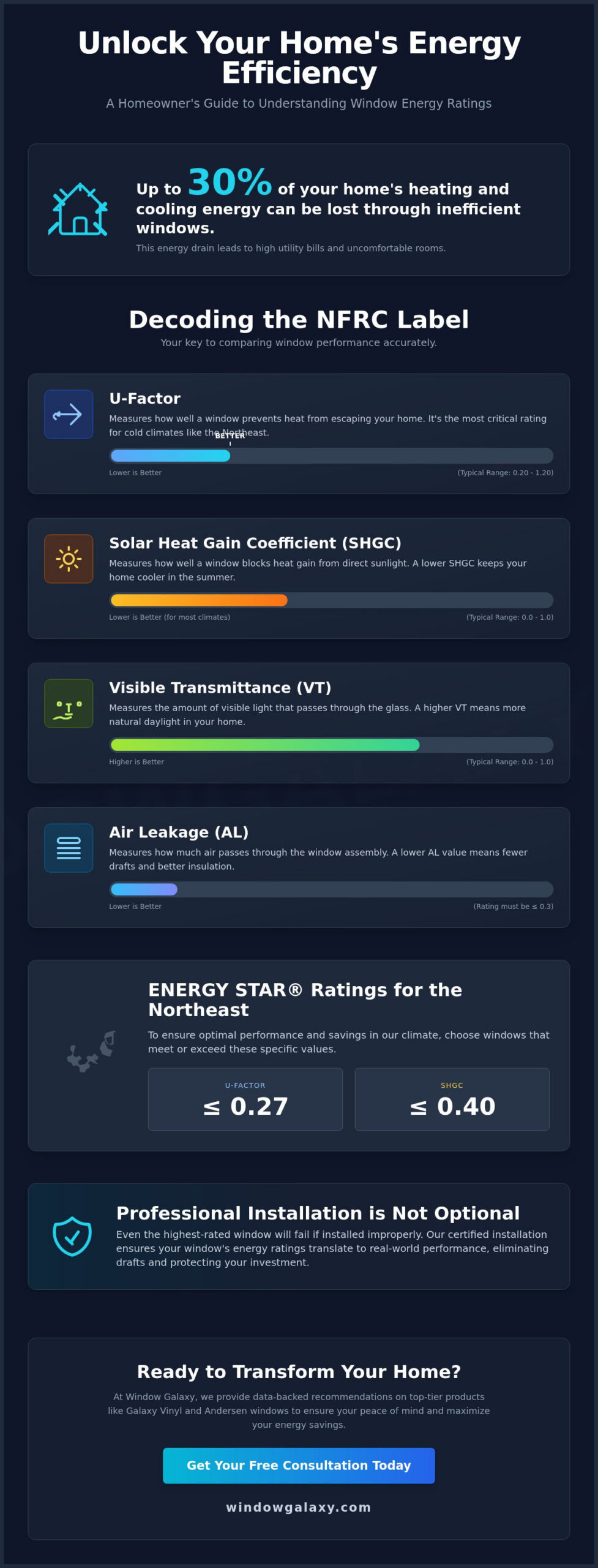
Your windows are much more than a simple view of the outdoors; they’re the primary barrier between your family and the elements. According to the U.S. Department of Energy, up to 30% of a home’s heating and cooling energy is lost through inefficient windows. This is why understanding window energy ratings is a vital step for any homeowner looking to protect their budget and their peace of mind. While it’s tempting to focus on frame colors or hardware styles, shifting your mindset to view windows as a performance investment ensures your home remains a sanctuary rather than a source of financial stress.
Think of these ratings as a standardized yardstick. They provide a transparent way to compare different products without relying on vague marketing claims. When you partner with Window Galaxy USA, we use these data points to help you select the right Galaxy Vinyl Windows or Andersen Windows for your specific space. This data-backed approach offers several benefits:
- Clear comparisons between different window styles and brands.
- Verification that your new windows meet modern efficiency standards.
- Confidence that your investment will deliver the performance you expect.
The Link Between Ratings and Monthly Savings
High-performance windows act as a shield that reduces the constant workload on your HVAC system. In the Northeast, where temperatures swing from freezing winters to humid summers, your furnace and air conditioner often run around the clock. By selecting windows with superior ratings, you’re ensuring long-term value for your home. We’ve seen that “cheaper” windows often result in higher utility bills over just a few years. A window that leaks air or fails to block solar heat forces your mechanical systems to work harder, which leads to unnecessary wear and tear on your equipment.
Improving Year-Round Indoor Comfort
You’ll feel the difference in comfort the moment our team finishes your installation. True comfort means sitting by a window during a cold New Jersey winter night without feeling a draft. Poorly rated windows often create “cold spots” that make entire rooms feel unusable during the winter. Conversely, the right glass prevents the “greenhouse effect” in sun-drenched rooms during July. Effective Window insulation is the secret to maintaining a consistent temperature in every room, and understanding window energy ratings helps you identify which products offer that level of protection. At Window Galaxy USA, we focus on every detail of the project to ensure your home remains peaceful and stable regardless of the weather outside.
Decoding the NFRC Label: U-Factor, SHGC, and Beyond
The NFRC label is essentially the “nutrition facts” for your home’s exterior. The National Fenestration Rating Council acts as a non-partisan watchdog, ensuring every manufacturer plays by the same rules. When you are understanding window energy ratings, this label is your most reliable tool because it allows you to compare different products on an even playing field. It’s the only way to verify that a window actually performs as promised once it’s in your wall. Without this standardized system, homeowners would be forced to rely on guesswork or unverified claims. Window Galaxy USA relies on these certified numbers to ensure every recommendation we make is backed by hard evidence.
One detail to watch for is the difference between “total window” ratings and “center-of-glass” ratings. Some products might claim high efficiency based only on the glass itself. However, the NFRC measures the entire unit, including the frame and spacers, to give you an accurate picture of real-world performance. You can find a deeper dive into these Energy Performance Ratings on the Department of Energy website. This comprehensive testing ensures that the Galaxy Vinyl Windows or Andersen Windows you choose will stand up to the specific demands of your home’s architecture.
U-Factor: The Key to Winter Insulation
In regions like New Jersey and New York, the U-Factor is often the most important number on the sticker. It measures how well a window prevents heat from escaping your living room. For homeowners in our area, lower numbers are always better because they signify a stronger barrier against the cold. Specifically, U-factor is the rate of non-solar heat flow. Choosing a low U-Factor means your furnace won’t have to work overtime during a January cold snap, providing a more stable and comfortable indoor environment for your family.
Solar Heat Gain Coefficient (SHGC): Managing Summer Heat
While U-Factor handles the cold, the SHGC manages the sun. This rating tells you how much solar radiation enters your home through the glass. In the Northeast, we look for a balanced SHGC. You want enough solar gain to help warm your home for free in the winter, but not so much that you’re baking in the summer. Modern low-E coatings are excellent at managing this balance. They reflect heat without making your rooms feel dark or gloomy. If you have questions about which coating fits your home’s orientation, our team at Window Galaxy USA is always ready to discuss your project details.
Visible Transmittance (VT) and Air Leakage (AL)
Visible Transmittance (VT) measures how much natural light comes through the glass. A higher VT means more daylight, which can improve your mood and reduce the need for artificial lighting during the day. Finally, Air Leakage (AL) is the secret to a draft-free home. It measures how much air pushes through the window’s seals and joints. To ensure a tight and efficient home, look for a rating of 0.3 cfm/sq ft or lower. Anything higher might leave you feeling a chill even if the glass itself is high-quality. Meticulous attention to these numbers ensures your investment delivers the performance you deserve.
Selecting the Right Ratings for the Northeast Climate
Many homeowners assume that a high-quality window is universal regardless of where it’s installed. In reality, a window designed to thrive in the Florida heat will often fail during a Pennsylvania blizzard. When you’re focused on understanding window energy ratings, you have to look through a regional lens. The Northeast falls primarily into the ENERGY STAR “Northern” climate zone, which means our homes face specific challenges that southern states don’t encounter. We need products that can handle massive temperature swings, from humid July afternoons to sub-zero January nights.
In our heating-dominated climate, the U-factor is your most critical metric. While southern homeowners prioritize blocking the sun’s heat, we must prioritize keeping our expensive indoor heat from escaping. The National Fenestration Rating Council provides the standardized data you need to make this distinction. By choosing a window with a lower U-factor, you’re building a stronger thermal envelope for your home. This isn’t just about efficiency; it’s about ensuring your family stays warm without your furnace running 24/7. We aim for the “Goldilocks” zone: finding that perfect balance where your home is insulated, well-lit, and protected from the elements.
ENERGY STAR Requirements for Our Region
To earn the ENERGY STAR label in 2026, windows in the Northern zone must meet strict Version 7.0 standards. For our region, this typically requires a U-factor of 0.22 or lower. These requirements are designed to ensure your home meets the highest levels of performance. At Window Galaxy, our Galaxy Vinyl Windows are specifically engineered to exceed these local weather extremes. We make sure every product we install is certified for your specific zip code. This precision gives you the peace of mind that your investment is actually rated for the wind and snow it will face.
Customizing Ratings for Different Sides of Your House
A truly professional project involves more than just picking one window model for the whole house. Your south-facing windows might benefit from a slightly higher Solar Heat Gain Coefficient (SHGC) to provide “free” heat during the winter months. Meanwhile, north-facing windows, which never see direct sun, need the absolute lowest U-factor possible to prevent heat loss. We also consider Visible Transmittance (VT) for darker rooms to help improve your home’s natural light and your overall well-being. Our project managers work with you to map out these specific thermal needs, ensuring every room in your home is optimized for comfort. This collaborative approach turns a standard replacement into a tailored performance upgrade.
How Professional Installation Protects Your Window Energy Ratings
The sticker on your new glass represents a promise of performance, but that promise is only as strong as the team holding the level. There is often a significant gap between the laboratory ratings on a label and the reality of how that window performs in your wall. Understanding window energy ratings requires acknowledging that a window is a component of a larger system. If a high-performance unit is installed with even slight misalignments, the energy efficiency you paid for can literally whistle through the cracks. You deserve a home that lives up to the data on the label, which is why precision is our baseline at Window Galaxy.
We’ve seen how poor sealing creates air bypasses that render even the best U-factor ratings irrelevant. If air moves freely between the window frame and your home’s framing, the expensive coatings on the glass cannot do their job. Maintaining the structural integrity of the unit through meticulous oversight is the only way to protect your investment. Our Window Installation Services focus on every millimeter of the fit to ensure your home’s thermal envelope remains unbroken.
The Danger of Air Leakage Around the Frame
A common mistake in the field is improper shimming. If an installer forces a window into place or uses too few shims, the frame can warp over time. This warping eventually breaks the factory seals, leading to permanent drafts and potential fogging between panes. We prevent this by using professional-grade insulation in the “rough opening” to create a continuous thermal barrier. Our process relies on a constant two-way dialogue between you and our project managers. This ensures no detail is overlooked and that your home remains airtight for years to come.
Ensuring Proper Sealant and Flashing Performance
The science of weather-tight seals involves more than just a bead of caulk. Proper flashing is essential to redirect water and prevent air infiltration. Without this, moisture can seep into your walls, leading to hidden damage and reduced thermal performance. Our structured project management approach ensures that our teams never take shortcuts in these critical areas. For a deeper look at how we manage every stage of your project, you can read The Ultimate Guide to Window Replacement.
We take pride in our punctuality and interpersonal respect, making sure your project is handled with the accuracy it deserves. If you’re ready to see how our meticulous installation process can transform your home’s comfort, contact Window Galaxy to schedule your consultation today.
Window Galaxy’s Commitment to High-Performance Energy Efficiency
At Window Galaxy, we believe that a window is only as good as the performance it delivers in your home. We’ve spent years refining our selection process to ensure that every product we offer meets the highest standards for thermal protection. Understanding window energy ratings is a core part of our consultation process because we want you to feel confident in your investment. We don’t just provide a catalog of options. We provide a curated selection of Galaxy Vinyl Windows and Andersen Windows that are specifically chosen for their ability to withstand the unique climate of our region.
Our approach combines high-tech products with expert project management to eliminate the stress of home improvement. We prioritize a two-way dialogue with every homeowner, listening to your concerns about drafts and high utility costs before suggesting a solution. This partnership ensures you get the right ratings for your specific home architecture and orientation. By focusing on the receptive side of the conversation, we can match you with windows that offer the exact balance of insulation and natural light your family needs.
Engineered for Excellence: Galaxy Vinyl Windows
Our Galaxy Vinyl Windows are a testament to modern engineering. These units feature multi-chambered frames that act as internal thermal breaks, significantly boosting U-factor performance by trapping air within the frame itself. This design prevents the transfer of cold from the outside to the inside of your home. When combined with our high-performance glass packages, these windows provide an elite level of protection against local weather extremes. For a deeper look at what makes our products stand out, check out our guide on Why Choose Galaxy Vinyl Windows.
Your Partner in Energy Efficiency
We remain committed to your peace of mind from the initial consultation through the final walkthrough. Every project is assigned a dedicated manager who oversees the quality of the installation and verifies that every unit performs as expected. We take pride in our punctuality and our meticulous attention to detail, ensuring that your home’s energy ratings are protected by a perfect fit. Our goal is your total satisfaction and the long-term relief that comes from a more comfortable, efficient home. If you’re ready to upgrade your home’s performance, contact Window Galaxy for a professional assessment and let our team handle the details with the accuracy you deserve.
Transform Your Home with Data-Backed Efficiency
Mastering the technical details of NFRC labels is the first step toward a more comfortable and cost-effective home. By understanding window energy ratings, you’ve gained the tools to choose products that thrive in our specific Northeast climate. Whether it’s selecting the right U-factor for a cold New Jersey winter or ensuring a draft-free seal through professional installation, your decisions now have a direct impact on your family’s comfort for years to come.
Window Galaxy is here to act as your dependable partner throughout this process. We provide NFRC certified products and expert project management to homeowners across NJ, PA, CT, NY, and DE. Our team prioritizes your peace of mind by ensuring every detail of your installation meets the highest industry standards. Don’t let confusing jargon or inefficient glass stand in the way of your home’s performance. Schedule your free energy-efficiency consultation with Window Galaxy today to start your next project with total confidence. We look forward to helping you create the temperature-stable sanctuary you deserve.
Frequently Asked Questions
What is a good U-factor for windows in New Jersey?
A U-factor of 0.22 or lower is the ideal target for New Jersey homes to meet the latest ENERGY STAR Version 7.0 standards. This rating ensures that your windows provide a strong thermal barrier against our freezing winter temperatures. At Window Galaxy, we offer products like Galaxy Vinyl Windows that are specifically engineered to meet or exceed these local requirements for maximum heat retention.
Is a higher or lower SHGC better for my home?
In the Northeast, you generally want a balanced Solar Heat Gain Coefficient (SHGC) rather than the extremely low numbers used in southern climates. A moderate SHGC allows some “free” solar heat to help warm your home during the winter while still blocking the most intense summer rays. We help you select the right glass coatings to ensure your home stays comfortable during every season without feeling dark or gloomy.
Does the ENERGY STAR label actually save me money?
Yes, replacing old windows with ENERGY STAR certified models can save homeowners between $100 and $600 per year on energy bills. These savings depend on your local climate and the condition of your original windows. By reducing the workload on your HVAC system, these high-performance products provide a reliable return on your investment through lower monthly utility costs.
What is the difference between U-factor and R-value?
U-factor measures the rate of heat loss through the entire window unit, whereas R-value measures a material’s resistance to heat flow. While insulation is typically described in R-value, the window industry uses U-factor because it’s a more accurate way to measure how glass, frames, and spacers work together. Remember that with U-factor, a lower number always indicates better insulating performance for your home.
Do all energy-efficient windows have a tint?
No, modern energy-efficient windows use microscopic Low-E coatings that are practically invisible to the naked eye. These advanced coatings reflect infrared light and heat without significantly reducing the amount of natural light entering your rooms. This means you don’t have to sacrifice a bright, airy atmosphere to achieve superior thermal protection for your family.
Can poor installation void my window’s energy performance warranty?
Yes, improper installation is one of the most common reasons manufacturer warranties are voided. If a window isn’t shimmed or sealed correctly, it can lead to frame warping and seal failure that negates the unit’s original energy ratings. Window Galaxy protects your investment by providing expert project management and meticulous installation services that adhere to all factory specifications.
How often should I replace windows to maintain energy efficiency?
Most windows should be replaced every 15 to 20 years to ensure your home stays protected by the latest thermal technology. Understanding window energy ratings is particularly helpful when you notice drafts or rising heating costs, as it allows you to compare your aging units against modern high-performance standards. If your current windows are more than two decades old, an upgrade can significantly improve your daily comfort.
