


What if your home’s exterior could act as a thermal blanket that slashes your utility costs and hushes neighborhood noise at the same time? With vinyl siding now accounting for 26% of the market in new home construction, many homeowners are weighing the choice of insulated vinyl siding vs standard options to meet stricter 2026 energy standards. It’s common to feel frustrated by siding that looks wavy or feels flimsy, especially when you’re facing high energy bills during the peak of summer or winter. We agree that your home should be a comfortable, quiet retreat that reflects your pride of ownership.
At Window Galaxy, we treat every project as a partnership focused on your peace of mind and long-term satisfaction. In this article, you’ll discover the critical differences in performance, energy efficiency, and durability so you can make an informed decision for your property. We will preview how the enhanced R-values of insulated panels compare to traditional materials and look at why this upgrade contributes to the 74.7% average return on investment seen with vinyl siding replacements.
Key Takeaways
- Learn the structural differences between standard PVC panels and systems featuring contoured foam backing to understand which provides better wall support.
- Evaluate insulated vinyl siding vs standard options by comparing R-values to see how continuous insulation prevents thermal bridging and lowers utility costs.
- Discover how the added thickness of insulated siding improves your home’s soundproofing and protects against impact damage from exterior debris.
- Use our professional checklist to determine which exterior material best suits your home’s age and existing insulation levels for maximum comfort.
- Experience the Window Galaxy approach to installation, which focuses on two-way dialogue and meticulous project management to ensure your peace of mind.
Understanding the Basics: Standard Vinyl vs. Insulated Siding
Choosing the right exterior cladding is one of the most significant decisions you’ll make for your home’s protection. When comparing insulated vinyl siding vs standard, it’s helpful to start with the physical structure of each product. Standard vinyl is a time-tested material made from polyvinyl chloride (PVC) that has been a leading choice in home construction for years. Insulated options take that same durable PVC and fuse it with a permanent layer of rigid foam. This structural difference changes how the siding performs against the elements and how it protects your interior comfort.
What Is Standard Vinyl Siding?
Standard vinyl siding consists of thin, lightweight panels designed to overlap and shield your home from rain and wind. Because these panels are relatively flexible, they’re installed with a small gap between the vinyl and your home’s sheathing. This creates a “hollow” profile. While this design is excellent for shedding water and resisting rot, it offers very little in terms of thermal resistance. It’s been a staple for homeowners because it’s low-maintenance and comes in a vast array of colors. However, since it’s hollow, it can sometimes feel flimsy or rattle during high winds if not installed with precision.
What Is Insulated Vinyl Siding?
This high-performance material is an upgraded version of the standard panel. Manufacturers take the vinyl exterior and permanently bond it to a layer of expanded polystyrene (EPS) foam. This foam is precisely contoured to fill the entire profile of the siding panel. The result is a “solid-core” product that feels much more like traditional wood when you touch it. Insulated siding was developed to address the weaknesses of the hollow-back design by providing a continuous layer of protection around the home’s exterior.
As we move through 2026, many homeowners are shifting toward these solid-core materials. This movement is driven by a desire for better energy performance and a more premium appearance. New building codes, such as the 2024 International Energy Conservation Code (IECC), now emphasize the importance of “continuous insulation” to prevent heat loss through the wall studs. By choosing an insulated system, you aren’t just putting a cosmetic skin on your home. You’re adding a functional layer that helps your HVAC system run more efficiently. At Window Galaxy, we believe in providing materials that meet these modern standards while ensuring your home looks its absolute best.
The Science of Comfort: R-Values and Thermal Bridging
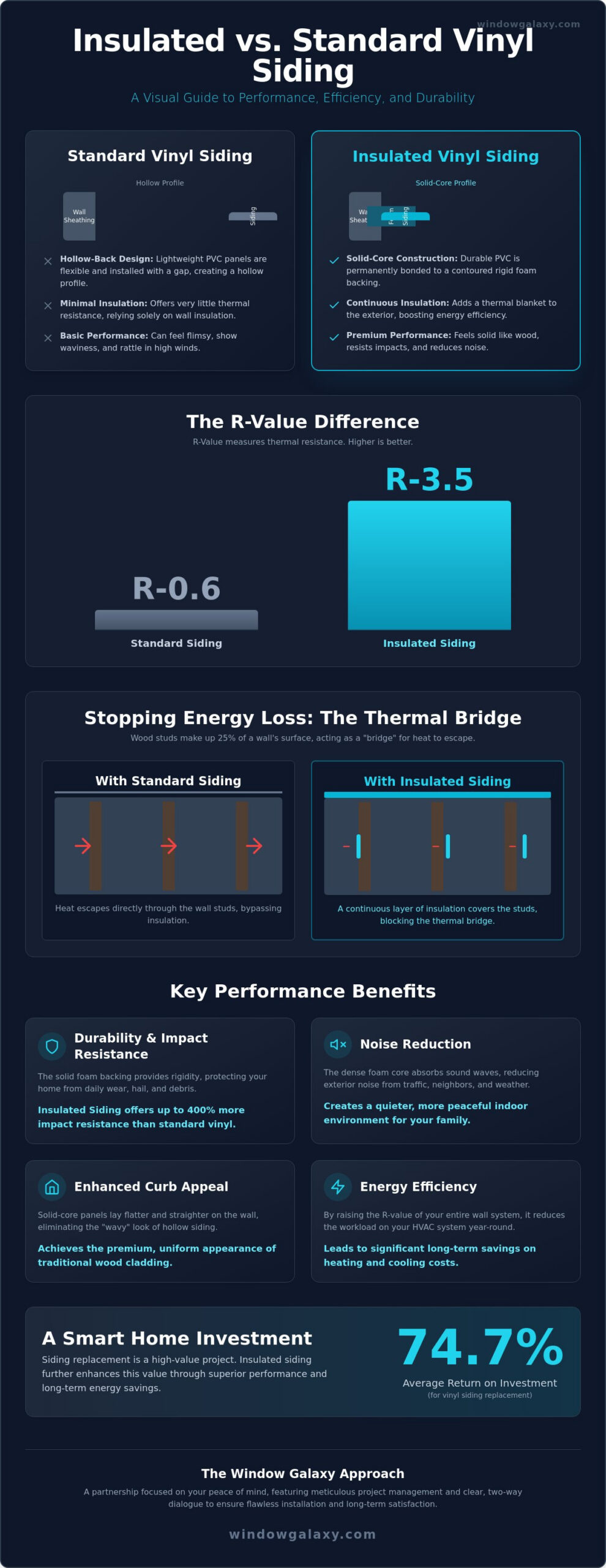
Understanding the math behind your home’s exterior is the first step toward a more efficient household. R-value is the standard measurement of thermal resistance. The higher the number, the better the material prevents heat from moving through it. When evaluating insulated vinyl siding vs standard, the gap in performance is wide. Standard vinyl siding has a very low R-value, typically between R-0.3 and R-0.6. This means it provides almost no thermal protection on its own. In contrast, insulated vinyl siding offers an R-value of roughly R-2.0 to R-3.5. By adding this layer, you’re essentially installing a protective shield that works 24/7 to keep your home’s climate stable.
Stopping Thermal Bridging in Its Tracks
Most homeowners believe their wall insulation is sufficient, but they often overlook the “thermal bridging” effect. In a standard wall, wood studs are positioned every 16 to 24 inches. While you have insulation between these studs, the wood itself acts as a bridge for heat to escape. Since studs make up about 25% of a typical wall’s surface area, a quarter of your home is basically uninsulated when using standard siding. Insulated siding provides “continuous insulation.” It covers the studs themselves, breaking that thermal bridge and creating a uniform thermal barrier. This leads to a more comfortable interior and significantly less work for your HVAC system. When your furnace or air conditioner doesn’t have to cycle as often, the equipment lasts longer and your utility costs stay more manageable. Homeowners in other regions often achieve similar efficiency by investing in spray foam insulation south florida to address thermal gaps from the inside.
Energy Efficiency in the Northeast Climate
In the Northeast, we deal with extreme temperature swings that test the limits of any siding. During a New Jersey winter, heat naturally wants to move toward the cold outdoors. In a New York summer, the humid heat tries to force its way inside. Insulated siding acts as a buffer against these forces. This protection is most effective when integrated with other high-performance components like replacement windows. Together, they form a total envelope seal that eliminates cold spots and drafts. This holistic approach ensures your home remains a sanctuary regardless of the weather outside. If you want to see how these systems work together in a real-world setting, reaching out to a professional at Window Galaxy can provide the clarity you need for your next project.
Comparing Performance: Durability, Sound, and Curb Appeal
Beyond energy savings, the debate between insulated vinyl siding vs standard panels often comes down to how the material stands up to the daily wear and tear of family life. Your home’s exterior is its first line of defense. While standard vinyl is a reliable choice, it lacks the structural reinforcement found in foam-backed systems. This difference affects everything from how the house handles a summer hailstorm to how quiet your living room feels on a busy afternoon. At Window Galaxy, we want you to feel confident that your investment will look just as good in ten years as it does on installation day.
Impact Resistance and Structural Integrity
Standard vinyl is hollow. If a baseball or a stray hailstone hits a traditional panel, the thin vinyl skin must absorb that force entirely on its own. In freezing temperatures, this lack of support makes the material brittle and prone to cracking or punctures. Insulated siding uses its contoured foam backing as a permanent shock absorber. The foam supports the vinyl from behind, significantly increasing its ability to withstand impacts without denting. When you touch the exterior of a home with insulated siding, it doesn’t rattle or flex. It has a solid, substantial feel that suggests long-term reliability.
Aesthetics: The “Straight-Wall” Appearance
One of the most common frustrations homeowners have with traditional siding is a “wavy” appearance. Most exterior walls aren’t perfectly flat. Standard vinyl is flexible, so it tends to follow every bump and dip in the underlying wood sheathing. Insulated panels are much more rigid. They bridge those small imperfections to create a smooth, “straight-wall” finish that stays level across the entire span of your home. The thicker profile also allows for deeper shadow lines. This creates a premium, high-end look that beautifully complements high-quality house windows and other architectural features.
Sound Dampening for Peace and Quiet
Peace and quiet are essential for a comfortable home interior. Standard, hollow-backed vinyl doesn’t provide much of a barrier against outside noise pollution. In some cases, the hollow space can even amplify the sound of heavy wind or rain. The expanded polystyrene core in insulated siding acts as an acoustic cushion. It absorbs vibrations and blocks sound waves from traffic, lawnmowers, and loud neighbors. For homeowners in busy residential areas, this added layer of soundproofing is often the deciding factor. It turns your home into a quiet sanctuary where you can relax without the constant intrusion of neighborhood noise.
Choosing the Right Exterior for Your Home’s Needs
Deciding between insulated vinyl siding vs standard panels isn’t just about picking a color. It’s about evaluating your home’s structural needs and your personal goals for the property. At Window Galaxy, we look at every project as a unique puzzle. We consider the age of your home, the quality of your current wall insulation, and how long you plan to live there. A successful exterior renovation should feel like a partnership where your peace of mind is the priority. It also pays to think about the “total envelope” of your home. High-performance siding works best when paired with custom windows that provide a matching level of thermal protection and aesthetic detail.
Your “length of stay” is often the most important factor in this decision. If you’re planning a quick refresh to sell a property, standard siding provides a clean, updated look that appeals to buyers. However, if you’re settling in for the next decade, the performance benefits of an insulated system start to compound. You’ll notice the difference in your energy bills and your interior comfort every single season. We believe in being honest and meticulous during this planning phase so you don’t over-invest in features you don’t need or miss out on benefits you’ll regret later.
When Standard Vinyl Is the Right Choice
Standard vinyl siding remains a popular choice for specific types of projects. If you’re updating a detached garage or a seasonal cottage that isn’t used during the winter months, the added thermal benefits of insulation might be unnecessary. It’s also an excellent option for homes that have recently undergone a deep energy retrofit with high-quality internal wall insulation. In these cases, your walls are already doing the heavy lifting. Standard siding is also a smart, budget-conscious choice for rental properties where you want to improve curb appeal and protect the structure without a long-term focus on utility savings. It’s lightweight, easy to replace if damaged, and offers a wide variety of styles to match any neighborhood aesthetic.
When to Invest in Insulated Siding
We typically recommend insulated siding for “forever homes” where you intend to stay for many years. Since you’ll be the one paying the energy bills, the long-term ROI from reduced HVAC strain becomes a major factor. It’s also the superior choice for older homes with drafty wall construction. If your house was built before modern insulation standards were established, adding a continuous layer of foam can make a dramatic difference in your daily comfort. Homeowners who want the most premium look also prefer these panels because they offer better rigidity and a flatter, more substantial appearance on the wall. If you’re ready to see how these options look in person, we invite you to contact our team for a professional consultation to find your perfect fit.
The Window Galaxy Approach to Flawless Siding Installation
Choosing between insulated vinyl siding vs standard panels is a significant decision for any homeowner, but the installation process is what truly determines if that investment performs as promised. At Window Galaxy, we believe that premium materials deserve meticulous craftsmanship. We don’t just “slap on” new siding. We view your home as a complex, integrated system where every component must work in harmony. This is why we emphasize the synergy between your exterior walls and your windows replacement project. When these elements are installed with the same level of care and precision, you achieve a total envelope seal that maximizes your home’s energy efficiency and daily comfort.
Our methodology is built on a foundation of trust and reliability. We understand that home improvement projects can feel overwhelming, so our primary goal is to alleviate that stress through professional oversight. Our team doesn’t just provide one-way updates; we prioritize a “Two-Way Dialogue” with every homeowner. This means we listen to your specific concerns and preferences before the first panel is ever cut. We want you to feel like a respected partner throughout the entire duration of the project, ensuring the final result reflects your vision for your home.
Expert Project Management from Start to Finish
Window Galaxy handles every detail of the installation so you can maintain your peace of mind. When you begin a project with us, you’re supported by a dedicated manager who organizes the entire timeline and maintains strict quality control. This professional ensures the installation team is punctual, organized, and treats your property with interpersonal respect. We follow a steady, methodical rhythm to keep the work on track without rushing the details. Our managers are hands-on, checking for accuracy at every corner, seam, and transition. This level of oversight prevents common installation errors that lead to moisture traps or air leaks. Whether your project involves insulated vinyl siding vs standard materials, our structured management style ensures the work exceeds standard requirements.
A Partnership Built on Trust and Communication
A successful exterior renovation relies on honest, transparent communication. We make a definitive ethical pledge to keep you informed at every stage of the process, from the initial delivery of materials to the final walkthrough. Our experts provide professional guidance to help you navigate the technical differences in siding profiles, ensuring you choose the best fit for your home’s architecture. We take immense pride in our follow-through and long-term client satisfaction. You deserve a contractor who is as meticulous and communicative as they are skilled with a hammer. We invite you to experience our customer-centric approach firsthand. Contact Window Galaxy for a professional consultation today and let’s start a collaborative journey toward a more beautiful, durable home.
Investing in Your Home’s Long-Term Comfort
Your property is a significant investment that deserves the highest level of protection and care. Deciding between insulated vinyl siding vs standard panels is more than a simple cosmetic choice; it’s a commitment to your home’s thermal envelope and structural integrity. By choosing a high-performance insulated system—and potentially pairing it with a professional roof installation from United Roofing & More!—you’re embracing a solid-core exterior that prevents thermal bridging, muffles neighborhood noise, and provides superior resistance against the unpredictable weather we face in the Tri-State area.
At Window Galaxy, we bring an A+ BBB rating and extensive industry credentials to every project we lead. We specialize in the unique needs of New Jersey and New York homeowners, ensuring that every installation is handled with meticulous attention to detail. From our initial two-way dialogue to the oversight of a dedicated project manager, we’re here to alleviate the stress of your exterior renovation and provide a result that exceeds your expectations.
Ready to transform your curb appeal and lower your utility costs? Schedule Your Professional Siding Consultation with Window Galaxy and take the first step toward a more comfortable, beautiful home. We look forward to partnering with you.
Frequently Asked Questions
Does insulated vinyl siding really save money on energy bills?
Yes, it reduces energy consumption by creating a continuous thermal barrier around your home. When evaluating insulated vinyl siding vs standard, the energy savings come from the foam backing that prevents heat from escaping through your wall studs. Standard vinyl offers very little insulation on its own. By keeping your home’s climate more stable, your HVAC system doesn’t have to work as hard to maintain comfort.
Is insulated siding thicker than standard vinyl siding?
Yes, insulated siding is significantly thicker because of the bonded foam core. While standard vinyl is a thin, hollow shell, insulated panels are solid. This extra thickness gives the material a more substantial, high-end feel. It also makes the panels more rigid, which helps them stay flat against your home’s exterior walls without the “waviness” often seen in thinner, more flexible materials.
Can I install insulated siding over my existing siding?
We generally recommend removing your old siding before installing a new system. Installing new panels over old ones can hide underlying rot or moisture issues that need to be addressed. A fresh installation allows our team to inspect the sheathing and install a proper house wrap. This ensures the best possible seal for your home’s thermal envelope and protects your long-term investment.
Does insulated vinyl siding help with outside noise?
Yes, the foam core acts as an acoustic cushion that absorbs neighborhood noise. It blocks sound waves from traffic, lawnmowers, and loud neighbors much more effectively than hollow panels. Many homeowners choose the insulated option specifically for this added peace and quiet. It turns your home into a sanctuary by dampening the vibrations that typically pass through standard, thinner siding materials.
How long does insulated vinyl siding last compared to standard?
Both materials have a long lifespan, but insulated siding often maintains its “new” appearance for a longer period. The foam backing prevents the panels from sagging or warping over time. It also protects the vinyl skin from impact damage that can cause cracks or punctures. With professional installation and project management, you can expect your siding to remain durable and attractive for decades.
Does insulated siding require more maintenance than standard vinyl?
No, it requires the same minimal maintenance as traditional vinyl. You won’t need to paint, stain, or seal the panels. A simple wash with a garden hose once or twice a year is usually enough to keep the surface looking fresh. The main difference is that the rigidity of the insulated core makes the panels less likely to trap dirt in gaps or bends.
Is insulated siding more resistant to hail and storm damage?
Yes, the foam core provides critical support that absorbs the force of impacts. In a storm, standard hollow vinyl can crack when hit by hail or wind-blown debris. Because the foam fills the space behind the vinyl, it acts as a shock absorber. This makes the material much more resilient during severe weather, especially in the freezing temperatures common in the Northeast.
Will insulated siding make my house look different than standard vinyl?
Yes, it creates a more premium, “straight-wall” look for your property. Standard vinyl is flexible and tends to follow the imperfections of your home’s walls. The rigid nature of insulated panels bridges those dips to create a perfectly level surface. You’ll also notice deeper shadow lines and a profile that more closely mimics the look of expensive cedar or wood planks.
