


What if those tiny gaps around your brand new frames aren’t just “normal settling,” but signs of a deeper installation error? You’ve likely spent weeks planning this upgrade, hoping to capture the 70% to 85% return on investment that vinyl windows currently offer in 2026. It’s incredibly frustrating to feel a draft or see condensation when you’ve just made a major financial commitment to your home. We understand that anxiety. A big part of communication is listening to your concerns before, during, and after the work is finished.
At Window Galaxy USA, we believe that a professional installation doesn’t end when the crew pulls away. This guide will help you troubleshoot common problems after window installation so you can distinguish between expected house movement and genuine red flags. You’ll learn how to inspect your seals, understand why your sashes might be sticking, and gain the peace of mind that your investment is fully protected. We’re here to show you how quality control and nonstop communication turn a stressful renovation into the joy you expected for your home.
Key Takeaways
- Perform a detailed “First-Day” walkthrough to identify visual imperfections like frame scratches or messy caulking before the installation crew departs.
- Use the “Whistle Test” to detect air leaks and other common problems after window installation that might compromise your home’s energy efficiency.
- Learn why inspecting the head flashing is vital for preventing hidden water damage that often stays invisible for months.
- Distinguish between normal house settling and genuine mechanical defects to understand when a professional adjustment is necessary.
- Discover how Window Galaxy’s nonstop communication and hands-on project management eliminate the stress of home renovation.
Spotting Immediate Red Flags After Your Window Installation
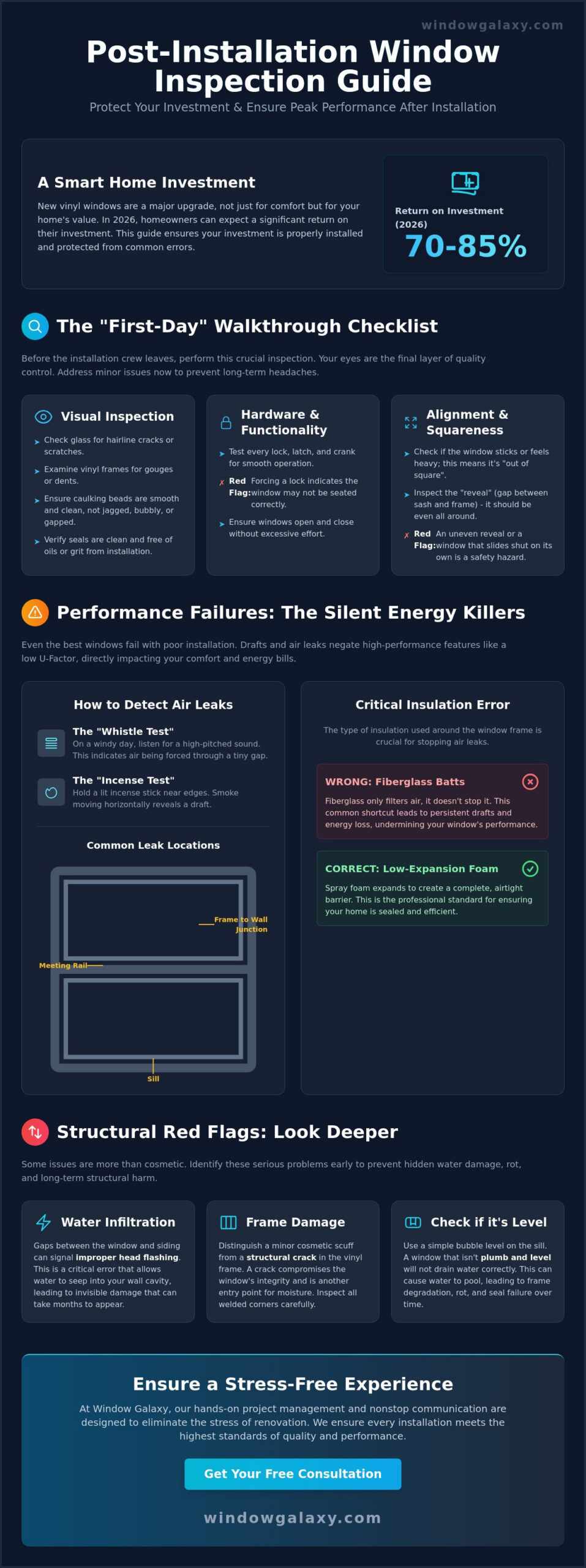
The moment your new windows are in place, you should feel a sense of relief and excitement. Identifying common problems after window installation begins with a systematic “First-Day” walkthrough before the installation team packs up their tools. While Window Galaxy USA project managers maintain strict quality control throughout the process, your eyes provide the final layer of security. This inspection is your best opportunity to address minor issues before they become long-term headaches.
Start by looking for visual imperfections that might have occurred during transport or handling. Check every inch of the glass for hairline cracks or scratches. Examine the vinyl frames for gouges or dents. A professional finish includes clean, smooth caulking beads. If the sealant looks jagged, bubbly, or has gaps, it won’t provide the airtight barrier you need to meet the updated 2026 Energy Star standards. Look at the job site itself. If installers have “dirty hands” from old debris, they can leave oils or grit on the window seals. This leads to permanent seal failure or premature wear on the weatherstripping. Testing hardware functionality is the next step. Every lock, latch, and crank should operate with precision and care. If you have to force a lock into place, the window might not be seated correctly. Smooth operation is a hallmark of a quality install and reflects our commitment to reliability at Window Galaxy USA.
Operational Issues: Sticking and Misalignment
A window that sticks or feels heavy to lift is often “out of square.” You can verify this by checking the “reveal,” which is the small gap between the window sash and the frame. If this gap is wider at the top than the bottom, the frame is tilted. This isn’t just an annoyance; a window that won’t stay open or slides down on its own is a safety hazard. Proper installation ensures the weatherstripping compresses evenly when the window is locked. This maintains the thermal performance required by local building codes.
Cosmetic Defects vs. Structural Damage
It’s vital to distinguish between a surface scuff and a structural crack. A crack in the vinyl frame can allow moisture to seep into your wall cavity. Look for gaps where the window meets the interior trim or exterior siding. These openings are often signs of Flashing errors, which can lead to significant water infiltration over time. Use a simple bubble level to ensure the unit is plumb. If the window isn’t level, it won’t drain water correctly, potentially leading to common problems after window installation like rot or frame degradation.
Performance Failures: Drafts, Condensation, and Noise
A performance failure happens when your high-tech investment fails to provide the thermal or acoustic barrier you were promised. You might have selected windows that meet the rigorous industry standards for window performance, but even the best glass can’t overcome a poor installation. These failures are often subtle at first. You might notice a slight chill near the glass or a new whistling sound during a storm. These are among the most frustrating common problems after window installation because they directly impact your comfort and your energy bills. At Window Galaxy USA, we prioritize your peace of mind by ensuring every unit performs exactly as engineered.
The “Whistle Test” is a simple way to identify air leaks. If you hear a high-pitched sound when the wind blows, air is being forced through a tiny gap in the sealant or frame. This air bypasses the window’s U-factor, which is the measure of how well a window keeps heat inside. For example, if you installed windows to meet the Northern Zone’s 0.22 U-factor requirement effective in 2026, a single air leak can render that efficiency useless. You’ve essentially paid for a high-performance barrier that has a hole in it. If you suspect your windows aren’t performing as they should, you can always ask our project managers for a professional evaluation to ensure your home remains protected.
Drafts and Air Leaks: The Silent Energy Killers
Air leaks typically hide in three places: the sill, the meeting rail where two sashes touch, and the junction where the frame meets your wall. You can find these micro-drafts by holding a damp hand or a lit incense stick near the edges on a breezy day. Smoke that wafts horizontally indicates a leak. Often, these cold spots occur because an installer used fiberglass batts instead of low-expansion spray foam behind the trim. Fiberglass doesn’t stop air; it acts like a filter. This mistake can cost you part of the $100 to $600 in annual energy savings promised by ENERGY STAR Version 7.0 models. Window Galaxy USA crews use precision and care to ensure these gaps are sealed airtight.
Condensation and Fogging: Is the Seal Broken?
Don’t panic if you see moisture on the outside of your glass. Exterior condensation actually proves your windows are thermally efficient. Interior condensation usually means your home’s humidity is too high. However, fogging located “between the glass” panes is a serious red flag. This indicates a premature seal failure. It often happens when the frame is twisted during installation, putting uneven pressure on the glass spacers until the seal pops. Identifying these common problems after window installation early ensures you can hold your installer accountable before the weather turns extreme.
Structural Red Flags: Water Infiltration and Flashing Errors
While air leaks impact your comfort, water infiltration poses a direct threat to your home’s structural integrity. These are among the most dangerous common problems after window installation because they often remain invisible for months. You might not see the consequences of a poor seal until six or twelve months after the project is finished. By the time you notice bubbling paint, soft drywall, or a faint musty smell near your baseboards, the internal wall framing may already be compromised. At Window Galaxy, we believe in a partnership that keeps your home protected long after the crew leaves, which is why we emphasize the importance of a meticulous inspection.
A professional window replacement involves more than just fitting glass into a hole. It requires strict adherence to the ASTM E2112 Standard Practice, which establishes the baseline for preventing air and water penetration. One of the most frequent sites for failure is the head flashing. This is the metal or vinyl shield that sits above the window. If it’s missing or installed incorrectly, gravity will pull rainwater directly behind the frame and into your house. Relying on “just a bead of caulk” to stop water is a recipe for disaster. Caulk eventually shrinks and cracks, whereas proper flashing provides a permanent mechanical barrier.
Improper Flashing and the Drainage Plane
Your home’s longevity depends on how well the window is integrated into the Water Resistive Barrier (WRB). This is often called the drainage plane. A correctly installed window features a “drip cap” that directs water away from the unit and over the exterior trim. A common error involves taping the bottom flange of the window frame. While it might seem like extra protection, this actually traps any moisture that finds its way inside, preventing it from draining out. This mistake turns a small leak into a major rot issue that can damage your wall studs and insulation.
Caulking Failures and Exterior Seals
Exterior sealant should act as your secondary line of defense, not the primary one. Look for “voids” or small gaps in the sealant where the window meets the siding. These openings are entry points for wind-driven rain. We use high-quality silicone that maintains its flexibility, unlike cheap latex sealants that dry out and pull away from the frame within a year. Professional installers also practice “back-caulking,” which involves applying a hidden bead of sealant behind the window flange. This provides a double seal that protects your home even if the outer layer is damaged by the elements.
Normal Post-Installation Adjustments vs. True Defects
It’s natural to feel a bit of protective anxiety after a major home improvement project. You’ve just invested in your home’s future, and every new sound or stiff handle might seem like one of the common problems after window installation. However, not every minor quirk is a sign of a failed project. High-performance units, including our Galaxy Vinyl and Andersen Windows, feature dense, multi-layered weatherstripping designed to create a laboratory-grade seal. When these are brand new, the seals are firm and haven’t yet been compressed by daily use. You might find that locking the sash requires a bit more physical effort during the first week. This isn’t a defect; it’s actually proof that your window is creating the airtight barrier you paid for.
Think of this as a “break-in” period for your home’s new eyes. Just as new shoes need a few miles to feel perfect, your window hardware and seals need a few dozen cycles to seat themselves properly. During the first 30 days, you are essentially stress-testing the precision and care of the install. If a window feels slightly heavy but operates smoothly once it’s moving, it’s likely just the newness of the components. If you have questions about how your new hardware should feel, schedule a follow-up consultation with our team to ensure everything is performing to our high standards.
When to Wait and When to Call
Your house is a dynamic structure that reacts to weight and temperature. When we replace 10 or 15 windows, we’re subtly changing how your walls distribute stress. A few minor pops or creaks during the first major temperature swing are often just the house adjusting to the new units. We recommend the “30-Day Rule”: test every function of every window exactly one month after the crew leaves. If a sash was easy to open on day one but is sticking on day 30, that’s a signal to call us back. Document these instances with clear photos and dates. This helps our project managers identify if a “settling” issue is actually a structural alignment error that needs a professional adjustment.
Understanding Manufacturer Warranties
There’s a big difference between a product warranty and an installation guarantee. A manufacturer’s warranty covers the glass, the spacers, and the vinyl frames against defects. However, it won’t cover a leak caused by poor craftsmanship. This is why choosing a reputable window replacement company is your best insurance policy. We act as your advocate. If a seal fails, we don’t just hand you a phone number for a factory; we manage the claim and the repair process from start to finish. Our nonstop communication ensures your investment stays protected by the people who installed it.
Ensuring a Stress-Free Experience with Window Galaxy USA
Home renovation shouldn’t feel like a gamble. Many homeowners experience deep anxiety over whether their financial investment will be wasted due to poor craftsmanship or unresponsive contractors. At Window Galaxy, we eliminate that stress through our “Nonstop Communication” promise. We understand that a big part of communication is listening to your specific needs before the first measurement is even taken. By choosing a partner that prioritizes meticulous project management, you can avoid the most common problems after window installation before they ever start. Our project managers are hands-on from the beginning of a project to its end, ensuring every detail meets our rigorous quality standards.
We don’t consider a job “done” just because the windows are in the openings. Our team performs a comprehensive multi-point inspection on every unit. We check the seals, test the hardware, and verify that the installation meets the 2026 ENERGY STAR Version 7.0 requirements for your specific climate zone. This precision and care are why our customers often report that we exceeded their expectations. We Keep Our Promises, and that includes ensuring your home is left cleaner than we found it. Our punctual and respectful crews treat your property with the same level of respect they would their own homes.
The Window Galaxy Installation Process
Success starts with a perfect fit. We specialize in custom windows designed to match the unique architectural needs of your home. Whether your house is part of the 41 year old average American housing stock or a brand-new build, a custom fit minimizes the need for excessive shimming or caulking. This reduces the risk of air leaks and structural misalignment. Because we handle the project management internally, you’ll never have to wonder “what’s next?” You’ll receive constant interaction and updates throughout the entire process.
Your Partner for the Life of Your Windows
Our relationship with you doesn’t end when the last nail is driven. We’re a local leader with deep roots in the community, holding multiple state licenses across NJ, PA, CT, NY, and DE. This regional expertise means we understand the specific local building codes and weather patterns that affect your home’s performance. We’re committed to your long-term satisfaction and peace of mind. If you’re ready for a worry-free upgrade that puts your needs first, schedule your free estimate with Window Galaxy USA today. Let us show you how a professional, customer-centric approach makes all the difference.
Protect Your Home with Professional Precision
You now have the tools to identify and resolve common problems after window installation before they threaten your home’s structural integrity. A truly professional installation is a partnership that extends far beyond the first day. By monitoring your windows through the initial 30-day break-in period and understanding the difference between normal settling and performance failures, you ensure your project delivers the 70% to 85% return on investment projected by Remodeling Magazine’s 2026 reports.
At Window Galaxy, we believe you deserve absolute peace of mind. We Keep Our Promises by providing hands-on project management and nonstop communication throughout NJ, PA, CT, NY, and DE. Don’t let the 41-year-old average age of American housing stock lead to functional failure in your home. Our meticulous approach ensures your new windows provide the beauty and energy efficiency you expect from the very beginning.
Schedule Your Stress-Free Window Estimate with Window Galaxy USA
We’re ready to help you upgrade your home with the precision and care it deserves. Your journey to a more beautiful, energy-efficient home starts with a team that listens.
Frequently Asked Questions
Is it normal to have condensation on the outside of my new windows?
Yes, exterior condensation is actually a sign that your high-performance glass is working perfectly. It happens when the outside glass temperature drops below the dew point, which proves that your home’s heat isn’t escaping to warm the outer pane. This is very common in high-humidity areas during the early morning hours.
Why do my new windows feel difficult to open and close?
New windows often feel stiff because the high-density weatherstripping hasn’t been compressed yet. This firm fit is necessary to achieve the airtight seal promised by modern energy standards. You’ll usually find that the hardware operates much more smoothly after 20 to 30 cycles of opening and closing.
What should I do if I find a scratch on the glass after the installers leave?
Contact your Window Galaxy project manager immediately and provide a clear photo of the damage. We prioritize nonstop communication to resolve these issues quickly. Our “We Keep Our Promises” guarantee means we’ll ensure your specialty windows or vinyl units meet our strict quality standards before we consider the job complete.
How can I tell if my new windows are actually energy efficient?
Check the NFRC label on your glass to verify it meets the 2026 requirements, such as a 0.30 U-factor in California or a 0.25 Solar Heat Gain Coefficient in Southern zones. You should also notice a significant reduction in temperature spikes near your windows during the hottest part of the day. This verified data confirms your home is properly insulated.
Can I fix a drafty window myself, or should I call the installer?
You should always call the installer rather than attempting a DIY repair. Trying to fix common problems after window installation yourself, like applying extra caulk or adjusting the sash, can inadvertently void your installation warranty. We’re here to provide professional adjustments that maintain the integrity of your home’s seal.
What happens if my window frame starts to pull away from the wall?
This is a serious structural red flag that requires an immediate professional inspection. It often indicates that the unit wasn’t properly shimmed or secured to the rough opening. We’ll send a project manager to evaluate the situation and ensure the frame is reset to prevent water infiltration and long-term damage to your siding.
How long should a professional window installation take?
A professional crew can typically replace 10 to 15 windows in 1 to 2 days. This timeline includes the removal of your old units, the precision installation of the new ones, and a complete job site cleanup. We’ll provide you with a specific schedule before we begin so your experience remains stress-free.
What does a ‘lifetime installation warranty’ actually cover?
An installation warranty specifically covers the labor and workmanship involved in the project. It protects you against common problems after window installation like air leaks, water penetration, or mechanical failures caused by improper setup. This provides an extra layer of security beyond the manufacturer’s warranty on the glass and vinyl frames.
